
I’ve had a few discussions with customers over the past few weeks / months where they have been asking why things are more expensive than they used to be.
The honest truth is that they are not wrong, computers have gone up in price over the past 7 – 8 months and it’s hard to see them coming down any time soon.
I’ll explain why this is and give you some real figures from our build costs below.
I’ll then show you how we are dealing with it and what we have seen others doing.
What is going on?
Basically the problem is AI.
When you ask ChatGPT or Claude a question, the AI model is not running on your PC, it is running in a datacentre somewhere in the world.
These datacentres are basically large temperature controlled warehouses with racks and racks of computers in them, they can cost billions of pounds to build.
Companies like Anthropic, nVidia, OpenAI and xAI are racing to build out more and more datacentres to run AI models and workloads on. Literally trillions of pounds have been funnelled into this pursuit.
It turns out that the computers and servers needed to run AI models require a lot of memory modules, similar to the ones used in standard desktop computers. So the large AI companies have been buying up the supply of RAM modules directly from the foundries that produce them.
OpenAI who make ChatGPT signed deals in late 2025 to secure around 40% of the global DRAM output for the next 2 years. That’s just one company, all the other big players are trying to secure similar deals.
The companies that produce RAM modules make more margin on the type of RAM that datacentres require than they do selling normal RAM modules into the retail pipeline. Due to this they have mostly all pivoted to suppling AI companies instead of normal consumer RAM suppliers.
Datacentres also need a lot of fast storage capacity so components that go into solid state hard drives are being bought up by AI companies at a similar rate.
2026 Component Pricing
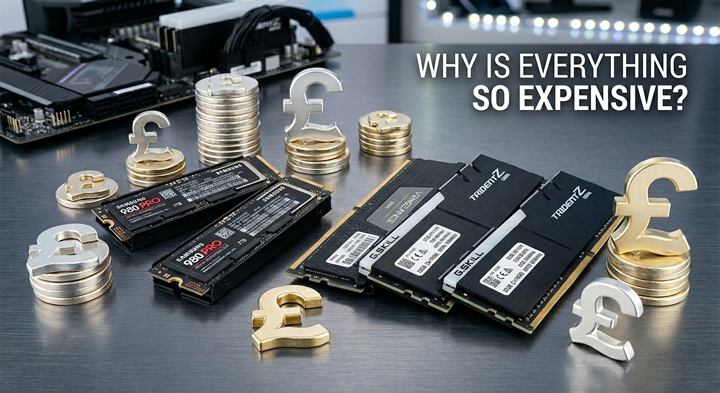
The lack of supply of RAM and solid state drives has caused pricing to shoot up. RAM is around 4 times higher priced than it was at the end of 2025. Solid state drives are over 3 times higher.
To give you a real world example, in September 2025 we could buy 32GB of DDR5 RAM for around £75 + VAT. That exact same kit now costs us £300 + VAT.
On our Extreme PC we used to offer 128GB of DDR5 for an upgrade price of £345 + VAT, that same upgrade price is now £1,095 + VAT and we honestly make less money on it now than we did 8 months ago.
Hard drives are similar. A 1TB solid state drive back in September 2025 was around £40 for a fairly decent model. Now you are looking at around £130 for the same item.
Impact on Computer Pricing in 2026
As a PC assembler it is impossible to fully absorb those kinds of cost increases, we have had to raise pricing.
Looking back at our pricing from just before the sharp price increases our base pricing has increased, but probably not by as much as you may think.
Our Ultra PC base price has increased by £100. This has always been our lowest cost machine and there wasn’t a lot of margin on it to begin with and no scope to lower the spec.
Our more powerful Extreme PC is actually currently priced exactly the same as it was in mid – late 2025. The only spec change was a drop from a 1TB SSD as default to a 500GB model.
Our popular Trader PC is priced £80 more than last year with no spec change on it.
Finally our most powerful Trader Pro PC is priced at just £50 more than last year. It has also dropped from a 1TB base SSD to a 500GB one but it has kept the 32GB of DDR5 RAM and it has even had a CPU upgrade to make it run faster.
What I would say is our margins have suffered, we are making less per PC than we were back in the middle of last year.
RAM and SSD upgrades are a bit of a different story, even though we are essentially pricing these upgrades at cost with no margin, pricing has increased. It’s more problematic for people looking at going to 64GB or 128GB of RAM levels.
What I would say is that for the vast majority of customers we deal with, very few ever need these amounts of RAM. 128GB is excessive. When customers ask us about it thinking they need it we often spend a little bit of time looking at their existing workload to find that they do not need anywhere near this amount.
What some other companies are doing
As a business owner I do spend some time occasionally looking at what other companies selling computers are doing.
The first thing to say is that everyone has had to raise prices, there is no getting away from that. Even the likes of Dell and HP are massively affected by sky high RAM and SSD pricing.
What I have seen a lot of though is companies offering older kit and / or cutting costs with other components.
For example, I’ve genuinely lost count on the number of times I’ve seen 11th and 12th generation Intel processors listed on competitors websites. The current Intel chips are essentially the 15th generation so when you are offered an 11th generation processor it is actually 5 years old.
12th generation i7’s and i9’s you see are marketed as high end, and they were, 4.5 years ago. Today they struggle to match ‘mid-range’ 14th gen i5 processors and they don’t get anywhere near the performance levels of the newer Intel Core Ultra series of chips.
A lot of these companies are also using cheaper components like power supplies and cases. Cheap power supplies have vastly shorter lifespans and are usually way noisier in operation, something they don’t tend to advertise on their websites.
I’ve also seen a lot of strange graphics card setups. Two separate enquiries over the past week have asked for my opinion on using a couple of GT 730 cards in a modern PC build. One guy wanted to run 7 high resolution screens off them.
I informed him that we used to use 730 cards, 10 years ago. The GT 730 chipset was released 12 years ago and struggles to support anything higher than a Full HD screen. I told him it would not be able to handle his screen setup.
What we won’t do
One thing I decided many years ago was that we were never going to sell crap.
As easy as it would be in the short term to throw in a budget power supply, install some cheap unreliable solid state drives, stick in a 12 year old graphics card, and use a basic low cost cooling system, just to get the price of our computers down by £100, maybe £150, we just won’t do it.
All of our builds still use premium BeQuiet power supplies and coolers, we still use good quality cases, we spec graphics cards that will actually handle modern screens and workloads.
We’d rather take the pain, lose some orders where people are buying solely on price, rather than sell stuff that we know is under-powered, old, or un-reliable.
Oh and we will never sell 2nd hand parts as new, something I know some others are doing…
What we will do
One thing we can do for you is actually look at your workload before recommending a PC.
We’ve always done this however when the cost between 32GB and 64GB of RAM used to be less than £100 many people just went for the higher amount. Now that the same upgrade costs around £300 we think it’s worth investigating whether your workload will actually need that upgrade.
If you are only using 19GB of RAM with everything up and running then with a 32GB system you still have 40% of your RAM never being used for anything. Put that same workload on to a 64GB system and you have 70% of your RAM sat doing nothing.
We can do similar investigations for processors and hard drives. It normally takes a couple of emails and maybe 5 – 10 minutes of your time to complete and you are left with a far clearer idea of what you really need in a new PC.
This could save you hundreds.
Future pricing outlook
Is the RAM and storage pricing just a short term blip? The industry is saying it’s probably here to stay, especially over the next few years.
AI demand is not reducing, if anything it is going up.
Companies who make these in-demand RAM modules can’t just make more either. A foundry which is required to produce these components can take 3 – 4 years to build at a cost of 10 – 20 billion, so there is no overnight solution to the problem of supply here.
Also, you should take into account that graphics cards have RAM on them so these cards will start costing more soon.
Even a very optimistic view of things puts this high pricing lasting until the end of 2027. The reality is it may never come back down, or it may take years longer.
What to do if you need a new computer
My advice is to get in touch with a reputable company. Discuss your actual workload with someone who knows what they are talking about and is interested in getting you a PC that works for you now and over the longer term.
If you’re shopping around then make sure to understand the performance and age of components in computer specs.
Also think about longevity, if you’re going to spend hundreds or thousands of pounds on a new computer then make sure it is built with good quality and reliable components, and it has a genuine support warranty supplied with it that lasts longer than a year.
Some cheaper components tend to have a 6 – 18 month lifespan in our experience.
Obviously we are happy to help, simply drop us an email or give us a call with your questions or requirements and someone will get straight back to you.